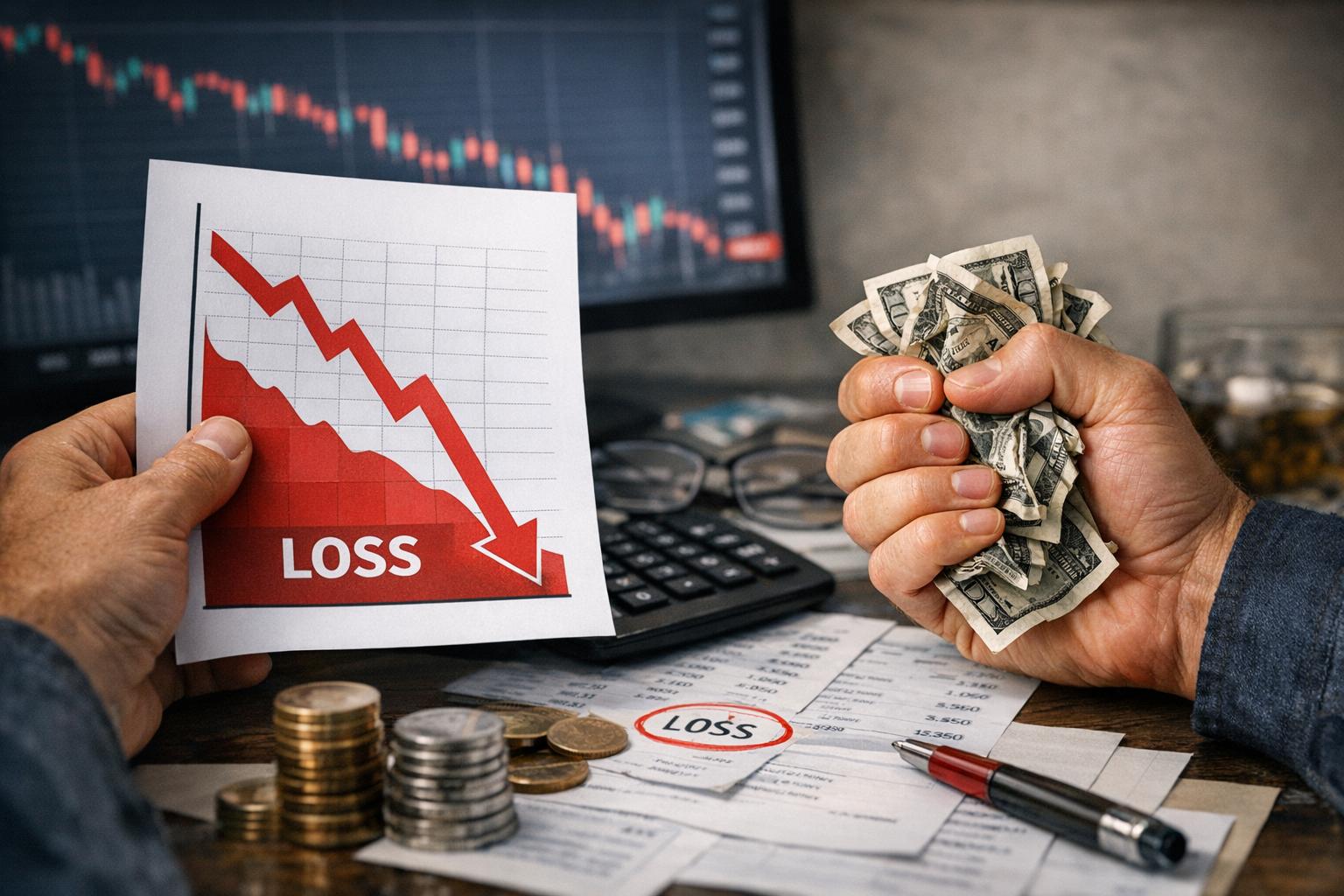
Loss aversion is the tendency to experience a financial loss more strongly than an equivalent gain. An investor may react more sharply to losing $1,000 than to gaining $1,000, even though both amounts have the same monetary value. The difference lies in how the outcomes are perceived, not in the arithmetic.
This behavioral tendency can affect asset selection, portfolio reviews, trading frequency, rebalancing, and responses to falling markets. It can encourage investors to avoid reasonable risks, sell after prices have already dropped, retain weak holdings, or take larger risks in an attempt to recover earlier losses. None of those actions automatically follows from poor judgment. The problem arises when discomfort replaces financial analysis.
Loss aversion does not mean investors should ignore falling prices. Losses may reveal a genuine problem with an asset, a portfolio, or a financial plan. The aim is to separate a reasoned response from one driven mainly by the desire to avoid admitting that money has been lost.
What Loss Aversion Means
Loss aversion is closely associated with prospect theory, developed by psychologists Daniel Kahneman and Amos Tversky. Prospect theory describes how people make choices involving uncertainty. Traditional economic models often assume that a person compares options according to expected financial value. Prospect theory proposes that people also judge outcomes against a reference point and react differently to gains and losses around that point.
Consider an investor who buys shares at $50. If the price rises to $60, the investor records a $10 gain. If it falls to $40, the investor records a $10 loss. The financial distance from the purchase price is equal in either direction. Yet the fall may produce a stronger response than the rise.
The original purchase price commonly becomes the reference point, although there is no financial rule requiring it to remain relevant. What matters at a later date is the investment’s expected return from its current price, its risks, and its role in the portfolio. The market does not know what an investor paid, and it has no duty to return to that figure. A mildly rude fact, perhaps, but a useful one.
Research often finds that losses carry more psychological weight than gains of the same size. That does not mean every investor values a loss at exactly twice the equivalent gain. The strength of the response varies according to the person, the amount involved, the source of the money, recent experience, and how the choice is presented.
Reference Dependence
Prospect theory treats gains and losses as changes relative to a reference point rather than as changes in total wealth alone. An investor with $500,000 may still react sharply to a $5,000 decline if attention is fixed on yesterday’s account balance. Another investor may view the same decline as routine variation within a long-term plan.
Reference dependence helps explain why two people can interpret the same result differently. Suppose a portfolio rises from $100,000 to $120,000 and then falls to $110,000. One person may focus on the $10,000 drop from the peak. Another may focus on the $10,000 gain from the starting value. Both calculations are correct, but each one produces a different frame for the decision.
Diminishing Sensitivity
Prospect theory also proposes that sensitivity to changes tends to decline as amounts move farther from the reference point. The difference between a $0 loss and a $1,000 loss may feel more pronounced than the difference between a $100,000 loss and a $101,000 loss, even though both changes equal $1,000.
This pattern can affect trading after an asset has already fallen heavily. Once an investor is far below the purchase price, another decline may receive less attention than the first one did. That can make continued risk-taking appear easier to accept, particularly if the investor is focused on returning to break-even.
Loss Aversion Is Not the Same as Risk Aversion
Loss aversion and risk aversion are related, but they describe different behavior. Risk aversion is a preference for a more certain outcome over an uncertain outcome with a similar expected value. Loss aversion concerns the extra weight placed on outcomes described or perceived as losses.
A risk-averse investor might prefer a stable bond return to a volatile share return because the bond provides more certainty. A loss-averse investor might accept or reject either investment depending on the reference point. The same person may avoid risk when ahead but accept greater risk when behind.
Suppose an investor can accept a certain loss of $5,000 or take a gamble with an equal chance of losing nothing or losing $10,000. Both choices have an expected loss of $5,000. A person focused on avoiding a confirmed loss may choose the gamble, even though it introduces the possibility of losing twice as much. This helps explain why loss aversion does not always make people conservative. In some settings, it can encourage riskier behavior.
How Reference Points Shape Investment Decisions
The purchase price is only one possible reference point. Investors may compare current wealth with a recent account high, a benchmark, an expected annual return, a retirement target, or the performance reported by a friend. Each comparison can alter how an outcome feels.
Recent highs are especially influential. After a portfolio reaches $300,000, the investor may begin treating that balance as money already owned. If the value falls to $275,000, the change may feel like a $25,000 loss even if the portfolio began the year at $250,000. This response is understandable, but it can distort the evaluation of annual performance and future prospects.
Expected returns can also become reference points. If an investor expects to earn 8 percent but earns 3 percent, the positive return may still feel like a loss relative to expectations. The investor may then change funds or managers even if the result was reasonable given market conditions and the amount of risk taken.
Benchmarks create another comparison. A diversified portfolio may rise by 6 percent while a major share index rises by 10 percent. The investor can feel left behind even though the portfolio was designed to hold bonds and cash as well as shares. Comparing a mixed portfolio with an equity-only index can make sensible diversification look like failure.
Anchoring to the Purchase Price
Anchoring occurs when a person gives too much weight to an initial figure. In investing, the purchase price often acts as that anchor. An investor who paid $80 for a share may refuse to sell at $55 because $80 appears to represent its proper value.
The purchase price records a past transaction. It does not show what the company is worth now. Earnings may have weakened, debt may have risen, management may have changed, or the industry may face lower demand. Waiting for the price to recover can be reasonable if the investment case remains sound, but waiting simply because $80 feels like the correct exit price is not analysis.
A useful test is to ask: If the position were held as cash today, would buying this asset at its current price make sense? A “no” answer does not always require an immediate sale because taxes, transaction costs, and portfolio rules may matter. It does show that the original purchase price has become too influential.
Loss Aversion and the Disposition Effect
The disposition effect is the tendency to sell assets showing gains while retaining assets showing losses. Loss aversion is one reason this behavior may occur.
Selling a profitable position confirms that the original decision worked. The investor receives both a financial gain and a sense of closure. Selling a losing position does the opposite: it turns an unrealized decline into a realized loss and appears to confirm that the initial judgment was wrong.
As a result, investors may sell successful holdings too early to protect gains. At the same time, they may give weak holdings more time than the evidence justifies. The portfolio can gradually fill with investments that have disappointed while its stronger holdings are reduced or removed.
Realizing gains is not inherently wrong. A holding may have become too large, its valuation may be difficult to justify, or the investor may need cash. Retaining a declining asset can also be sensible when the long-term case remains intact. The disposition effect concerns the reason for the action: gain or loss status receives more attention than expected return, valuation, and portfolio fit.
A Simple Example
An investor owns two shares. Share A was bought for $40 and now trades at $55. Share B was also bought for $40 but now trades at $25. The investor needs to sell one position.
If the investor sells Share A only because it shows a profit, the decision protects a positive result. If Share B has weaker finances and poorer future prospects, however, selling Share A may leave the portfolio holding the less attractive company.
The relevant comparison starts from current prices. Which share offers the better expected return after accounting for financial strength, valuation, taxes, and risk? Past gains and losses may affect tax treatment, but they do not by themselves identify the stronger investment.
Loss Aversion During Market Declines
Broad market declines bring loss aversion into plain view. Falling account balances create a sense that action is required, even when the investment plan already allowed for such periods. Financial news, account alerts, and repeated price checks can reinforce that pressure.
Shares and other market-priced assets fluctuate. A diversified equity portfolio can fall over weeks, months, or longer periods. Severe declines have occurred before and will occur again. Historical recoveries do not guarantee that every market, security, or fund will recover on an investor’s preferred schedule.
Loss aversion may cause an investor to move into cash after a fall. The sale reduces exposure to further declines, but it creates a new decision: when should the money be reinvested? Investors often wait for conditions to feel safer. By then, prices may already have risen.
Market recoveries rarely arrive with a polite notice. Strong return days can occur during unstable periods, sometimes close to sharp declines. An investor who sells and waits for reassuring news may miss part of the rebound, then face the uncomfortable choice of buying back at a higher price.
Remaining invested is not always correct. A decline may reflect weakening company finances, credit stress, fraud, excessive valuation, or a change in the investor’s need for cash. The distinction lies between reacting to a lower price and responding to new facts.
Myopic Loss Aversion
Myopic loss aversion refers to the combination of loss sensitivity and frequent evaluation. The more often investors review a volatile portfolio, the more often they are likely to observe a decline. Each observed decline can feel like a separate negative event, even if the long-term result remains positive.
A share portfolio may show many losing days during a profitable year. An investor checking prices several times each day receives a steady stream of gains and losses. Someone reviewing quarterly or annually sees fewer observations and may focus more readily on progress toward financial goals.
Less frequent checking does not remove financial risk. It can reduce the temptation to respond to random price movement. Review frequency should still reflect the portfolio, the investor’s responsibilities, and any approaching need for funds.
Effects on Asset Allocation
Asset allocation divides a portfolio among categories such as shares, bonds, cash, property, and other assets. The allocation has a major influence on expected return, volatility, and the size of potential declines.
Loss aversion may lead an investor to hold more cash or short-term bonds than the financial plan calls for. Cash offers price stability and ready access, which can be appropriate for emergency reserves and near-term spending. Yet a high cash allocation held for decades may lose purchasing power after inflation and tax.
That loss is less visible because the account balance may not fall. If prices rise faster than cash returns, however, the money buys less over time. Loss aversion often gives more weight to visible market declines than to the gradual erosion caused by inflation.
The reverse pattern can occur after a large loss. An investor may increase exposure to speculative shares, leveraged products, options, or concentrated positions in an attempt to return quickly to a former account balance. The old balance becomes a target, and normal risk controls are set aside.
A sound allocation accounts for the investor’s goals, withdrawal schedule, income, debt, tax position, time horizon, and likely response during a downturn. A portfolio may look efficient on paper yet fail in practice if the investor sells whenever it falls by 10 percent.
How Allocation Changes the Experience of Loss
| Portfolio feature | Possible behavioral effect | Planning consideration |
|---|---|---|
| High share allocation | Larger short-term fluctuations may trigger selling | The investor needs enough time and financial capacity to withstand declines |
| High cash allocation | Stable balances may reduce anxiety | Inflation can weaken future purchasing power |
| Concentrated holdings | One company can dominate gains and losses | Company risk may exceed what the investor intends to accept |
| Mixed assets | Different return patterns may make declines easier to manage | Diversification cannot prevent every portfolio loss |
| Leveraged exposure | Losses may grow quickly and prompt forced sales | Borrowing costs and margin requirements require close review |
Risk Tolerance, Risk Capacity, and Required Risk
Loss aversion is related to risk tolerance, but portfolio decisions also depend on risk capacity and required risk.
Risk tolerance is an investor’s willingness to accept uncertain returns and falling account values. It concerns behavior and personal preference. Risk capacity is the financial ability to absorb a loss without damaging core goals. Required risk refers to the amount of investment risk that may be needed to pursue a target return.
An investor can have high financial capacity but low tolerance. A well-paid professional with decades until retirement may have the resources to withstand a market decline but still sell after a modest fall. Building a portfolio solely around capacity may lead to repeated changes at poor times.
The opposite combination also occurs. A retired investor may feel comfortable holding volatile assets but depend on the portfolio for near-term living costs. Personal confidence does not remove sequence-of-returns risk, which is the danger that withdrawals during an early market decline will deplete the portfolio faster than planned.
Required risk deserves care as well. If a financial goal depends on an unrealistically high return, taking more risk may not repair the plan. The target, contribution rate, spending level, or time frame may need revision.
Common Loss-Averse Investment Decisions
Selling Winners Too Soon
An investor buys shares at $30 and sells them at $40 because losing the gain would feel wasteful. The sale may be sensible if the shares have become expensive or if the position exceeds the intended allocation. It becomes loss-averse behavior when protecting the gain is the main reason and future prospects receive little attention.
Holding Weak Investments Until Break-Even
A fund bought at $100 falls to $70 after persistent management problems and poor execution. The investor waits for a return to $100 before selling. This break-even rule feels orderly, but it gives the original price an authority it does not have. The better question concerns what the fund is likely to earn from $70 compared with available alternatives.
Moving Entirely to Cash After a Decline
A retirement account falls by 18 percent during a broad sell-off. The investor sells all growth assets and moves into cash. Prices later recover, but the investor postpones reinvesting because another decline still appears possible. One decision meant to stop losses becomes a long period outside the market.
Refusing to Rebalance
After shares fall, rebalancing may require selling some bonds and buying shares. A loss-averse investor may resist buying the asset that has just declined. Without rebalancing, the portfolio can remain more conservative than planned and participate less in a later recovery.
Taking More Risk to Recover
An investor loses $20,000 and then buys highly speculative securities to recover it quickly. The target is not based on the securities’ merits. It is based on returning to a former wealth level. This behavior resembles chasing losses in gambling and can produce much larger declines.
Avoiding Investment Altogether
Some savers postpone investing because any market loss feels unacceptable. They remain in cash for many years, even when the money is intended for retirement several decades away. Cash may prevent a quoted price decline, but it does not remove inflation risk or the risk of saving too little.
Why Losses Attract So Much Attention
Losses may signal a threat to future security. A falling retirement account can be interpreted as reduced housing, healthcare, or spending capacity rather than as a temporary market movement. That interpretation gives losses more weight than an abstract percentage on a statement.
Modern brokerage platforms also make price changes hard to ignore. Daily profit-and-loss figures, colour coding, notifications, and account rankings direct attention to recent movement. A red number feels immediate even when the investor will not need the money for twenty years.
Regret plays a role. Selling at a loss can feel like an admission that the original choice was wrong. Keeping the position leaves open the possibility of recovery and postpones judgment. This may protect self-image for a while, though it does nothing to improve the asset.
Social comparison can add pressure. An investor holding a balanced portfolio may hear that a colleague earned a high return from one technology share or a speculative asset. The balanced portfolio then appears disappointing by comparison. The colleague may omit the losses, concentration, or luck involved. Investment stories tend to arrive with selective editing.
Personal history matters too. Someone who invested shortly before a severe market decline may remain cautious for years. An investor who has known only rising markets may underestimate loss sensitivity until the first serious fall. Stated tolerance on a questionnaire does not always match behavior when real money is involved.
How Loss Aversion Affects Portfolio Measurement
Performance reporting can influence investor behavior through the choice of time period and benchmark. Daily returns may highlight random movement. A one-year return may be unsuitable for judging a strategy intended to operate across a full market cycle.
Account-level returns also need context. A portfolio can fall because markets declined, because the allocation was too risky, because holdings performed poorly relative to peers, or because the investor withdrew money. Those causes call for different responses.
Investors should distinguish among the following figures:
-
Market value: the current value of the holdings.
-
Cost basis: the amount paid, adjusted where applicable for transactions and tax rules.
-
Total return: price movement plus income such as dividends or interest.
-
Money-weighted return: performance that reflects the timing and size of deposits and withdrawals.
-
Time-weighted return: performance designed to reduce the effect of external cash flows.
Focusing only on whether the market value sits above or below cost can produce an incomplete view. Income, fees, tax, cash flows, and the period held may all affect the result.
Practical Methods for Managing Loss Aversion
Loss aversion cannot be removed by reading one behavioral finance article. It can, however, be managed through portfolio structure, written rules, and better decision habits.
Write an Investment Policy
An investment policy records the purpose of the portfolio, intended allocation, acceptable allocation ranges, contribution plan, rebalancing rule, and reasons that may justify a sale. It should be written during a calm period rather than during a market fall.
The policy does not need to be long. A private investor may use a few pages. Its value comes from making decisions before prices begin influencing judgment. If the policy says shares will be reduced only when allocation limits are breached or the investment case changes, a bad trading day alone does not qualify.
Match the Portfolio to Real Behavior
Risk questionnaires can help, but past actions often provide better evidence. An investor who sold during earlier declines should not assume that the next downturn will feel easier. A somewhat more conservative allocation that can be maintained may produce a better result than an aggressive allocation repeatedly abandoned.
Capacity for loss should also be tested with amounts rather than percentages alone. A 20 percent decline may sound manageable until it is translated into a $100,000 fall on a $500,000 portfolio. Reviewing both figures makes the trade-off clearer.
Set a Suitable Review Schedule
Long-term investors rarely need to monitor every market movement. Scheduled monthly, quarterly, or semiannual reviews may reduce impulsive trading while still allowing proper oversight.
Reviewing less often should not become neglect. Changes in employment, spending needs, tax status, health, or time horizon can require action. The purpose is to reduce reactions to noise, not to ignore the plan.
Use Rebalancing Rules
Rebalancing returns asset weights to their intended levels. It can be done on a schedule, such as annually, or when an allocation moves beyond a set band.
Threshold-based rules can reduce arbitrary decisions. If shares have a target weight of 60 percent with an allowed range of 55 to 65 percent, no trade is required while the weight remains inside that band. When it moves outside, the rule provides a reason to act.
New contributions and withdrawals can often help rebalance without selling. Directing new money to an underweight asset may reduce transaction costs and taxable gains.
Automate Contributions
Regular automated contributions remove the need to approve each purchase. Money is invested during rising, falling, and flat markets. This approach cannot guarantee a profit or protect against loss, but it reduces the temptation to wait for a perfect entry point.
Investors should still maintain an emergency reserve and avoid investing money needed soon. Automation works best as part of a financial plan, not as a substitute for one.
Separate Near-Term Spending From Long-Term Assets
Holding cash or short-duration assets for upcoming expenses can reduce pressure to sell shares during a decline. A retiree may reserve funds for near-term withdrawals while investing later spending needs with a longer horizon.
The appropriate reserve depends on income sources, spending flexibility, portfolio size, and tax. Too much cash can weaken long-term return, while too little can force sales at an awkward time.
Use Decision Checklists
A short checklist can slow a rushed sale. It may ask whether the investment case has changed, whether the allocation is outside its permitted range, whether cash is needed, what taxes apply, and what asset will replace the holding.
The replacement question matters. Selling is only half a decision. Moving from a declining fund to cash may reduce immediate volatility, but the investor still needs a plan for that cash.
Separating Price Declines From Investment Deterioration
Not every falling asset is a bargain, and not every fall is a reason to sell. Investors need to distinguish price movement from a change in the asset’s financial case.
For a company share, relevant questions may concern revenue, margins, debt, cash flow, management, valuation, and industry demand. For a bond, attention may turn to interest rates, maturity, inflation, and the issuer’s ability to pay. For a fund, investors may review mandate changes, fees, tracking difference, manager turnover, and portfolio concentration.
A broad market decline can pull down sound companies along with weak ones. A company-level decline may reflect poor results that do not affect the wider market. The same percentage loss can therefore carry very different meaning.
Investors should also examine whether their original case depended on facts or hope. If the reason for holding can be reduced to “it should get back to my purchase price,” the analysis needs work.
Tax Treatment of Investment Losses
Realized investment losses may have tax value, depending on local law, account type, holding period, and the nature of the asset. Some tax systems allow capital losses to offset capital gains, with unused amounts carried into later years under stated conditions.
Tax-loss selling can make economic sense when an investor disposes of a losing asset, records the loss for tax purposes, and moves into another suitable holding. Rules may restrict the tax benefit if the same or a substantially identical asset is repurchased within a stated period.
Taxes should not dominate the investment decision. Keeping a weak asset solely to avoid recognizing a loss may lead to a larger financial cost. Selling a sound asset solely for a tax benefit may also be unwise if the replacement has higher fees, different risks, or poorer market exposure.
Tax law changes and varies by jurisdiction. Investors dealing with large amounts, business holdings, inherited assets, or multiple account types may need advice from a qualified tax professional.
The Role of Financial Advisers and Brokerage Platforms
A financial adviser can act as a decision buffer during periods of market stress. The adviser may compare a proposed trade with the written plan, model the effect on future goals, and identify whether the client is reacting to a reference point.
Advice does not remove behavioral bias. Advisers can also be influenced by recent performance, client pressure, and fear of regret. A clear process, transparent fees, and documented recommendations remain necessary.
Brokerage platform design can either encourage or reduce loss-focused behavior. Frequent alerts, prominent daily return figures, and easy trading may increase activity. Tools showing goal progress, long-term total return, asset allocation, and projected cash needs may direct attention to more useful measures.
Ease of trading is convenient, but convenience can turn a passing thought into a transaction within seconds. Some investors benefit from adding friction, such as a waiting period before non-routine trades or a rule requiring written reasons for each sale.
Limits of Loss Aversion as an Explanation
Loss aversion is a useful model, but it should not become a label for every cautious decision. An investor may prefer stable assets because the money is needed next year. Selling after a fall may be rational if the asset no longer meets its stated purpose. Avoiding leverage may reflect sound risk control rather than behavioral bias.
Research does not produce one fixed estimate for the strength of loss aversion. Results vary with study design, stakes, probability, framing, and participant experience. Some researchers also debate how consistently loss aversion appears across all forms of choice.
Behavior can change over time. Experience may make an investor more comfortable with ordinary volatility, or a change in health and employment may make losses harder to bear. A person can also be loss-averse in one account and less concerned in another. Investors often treat pension money, inherited money, and trading profits differently even though every dollar has the same spending power.
Outcome bias should be avoided as well. A decision is not automatically good because the asset later rose, nor bad because it later fell. Decisions should be judged by the evidence available at the time, the process used, and whether the risk matched the investor’s plan.
A Structured Process for a Falling Investment
When an investment declines, a structured review can prevent the purchase price from controlling the decision.
-
Identify the reference point. Note whether attention is fixed on cost, a recent high, a benchmark, or a target balance.
-
State what changed. Separate new financial facts from price movement and market commentary.
-
Review the original reason for ownership. Check whether that reason still holds and whether it was supported by evidence.
-
Assess portfolio fit. Review allocation, concentration, time horizon, liquidity, and upcoming withdrawals.
-
Compare current alternatives. Ask whether the asset would be bought at its present price if the money were held in cash.
-
Account for costs and tax. Include dealing fees, spreads, taxable gains or losses, and the characteristics of any replacement.
-
Document the decision. Record why the position is being held, reduced, or sold and what evidence would prompt another review.
This process does not guarantee the correct result. Markets remain uncertain, and reasonable investors can reach different judgments. It does reduce the chance that a trade is based mainly on the discomfort of seeing red figures.
Putting Loss Aversion in Perspective
Loss aversion affects investment decisions because financial losses tend to carry more psychological weight than equal gains. It can encourage early sales of profitable assets, prolonged ownership of weak assets, excessive cash holdings, panic selling, or riskier attempts to recover previous wealth.
Recognizing the pattern does not require investors to ignore losses. Some losses provide evidence that an investment case has failed or that a portfolio takes more risk than the owner can bear. The task is to decide whether action follows from new facts, financial needs, and portfolio rules rather than from the desire to return to an old account balance.
Written policies, suitable asset allocation, scheduled reviews, diversification, automated contributions, and disciplined rebalancing can reduce the influence of short-term reactions. Tax and transaction costs also deserve attention, especially before replacing a holding.
A workable portfolio must do two jobs. It must support the investor’s financial objectives, and it must remain tolerable during periods when prices move in the wrong direction. Loss aversion matters because a mathematically sound plan has little value if it is abandoned at the first serious decline.