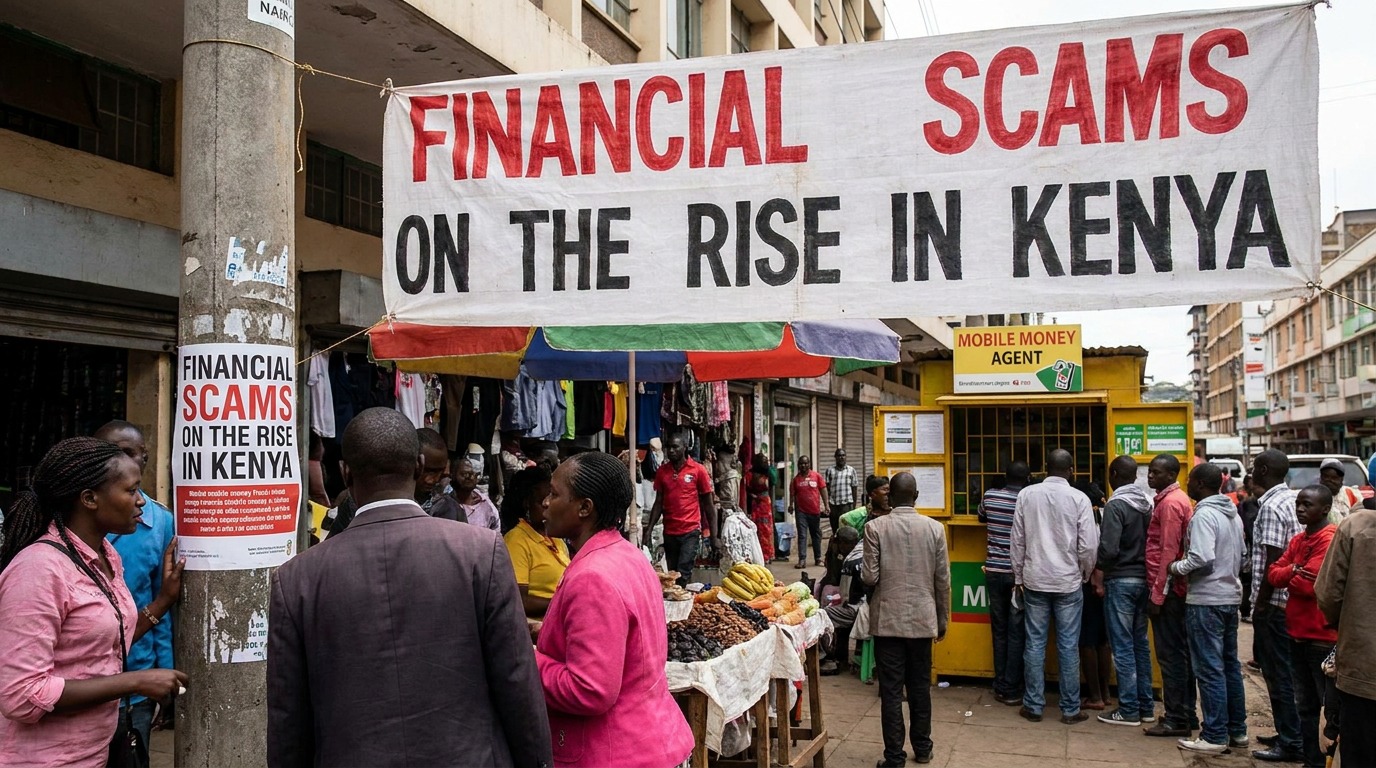
Financial scams are becoming a more visible problem in Kenya as investing, mobile money and online trading move further onto phones and social media. The same technology that has made it easier to open a legitimate trading account or invest in a fund has also made it easier for fraudulent operators to imitate financial companies, collect deposits and disappear.
Recent figures show why regulators are paying attention. A Communications Authority consumer complaints report covering April to June 2026 recorded 110 complaints involving digital financial services and mobile money. Of those, 86 were directly connected with fraud and scams, including phishing, fraudulent mobile money transactions, impersonation and social engineering. The Authority said digital networks were increasingly being exploited by criminals targeting consumers.
Investment fraud is only part of this wider problem, but it is a particularly expensive one. Kenya’s Capital Markets Authority issued an investor warning in May 2026 about unlicensed investment schemes involving shares, money market style products, forex and crypto. According to the warning, unlicensed firms were using social media, messaging applications, websites and trading platforms to attract investors with unusually high returns.
The warning was followed by another CMA advisory in July 2026 concerning fraudsters impersonating licensed financial firms through social media, applications and fake websites. That is an important change in how investors need to think about fraud. Checking that a company with a particular name exists is no longer enough. The investor also has to establish that the website, telephone number, salesperson and bank account actually belong to that company.
Kenya has a legitimate and regulated investment sector. It also has a growing number of criminals trying to borrow its appearance.
Why Financial Scams Are Spreading Online in Kenya
Kenya’s financial system is highly digital. A person can move money from a mobile phone, open an investment account online, communicate with an adviser through WhatsApp and monitor a trading account without entering an office. That convenience is useful for legitimate finance, but it removes some of the physical signals investors once used to judge whether a business was real.
A fraudulent investment operation does not need an impressive office in Nairobi. It can operate through a website, several WhatsApp numbers and a mobile payment channel. The people involved may not even be in Kenya.
The cost of creating a professional looking investment site has also fallen. Market charts can be embedded into websites, company logos copied and account dashboards created fairly cheaply. A fake trading application can display real market prices while the supposed customer account behind it is entirely fictional.
Social media gives the operator a relatively inexpensive way to find potential customers. Advertising can be aimed at people interested in forex, crypto, investing or making money online. Private messaging then moves the conversation away from the public platform.
That pattern has appeared in actual Kenyan investigations. In February 2026, INTERPOL said Kenyan authorities made 27 arrests connected with fraudulent investment schemes promoted through messaging applications, social media and fake testimonials. Victims were encouraged to make small initial investments, sometimes starting around USD 50, and were shown fabricated statements or investment dashboards. Withdrawal requests were then blocked.
The small initial payment is an important part of the method. Asking somebody for KSh5,000 is easier than asking for KSh500,000. Once the first amount apparently produces a profit, the victim may become comfortable adding considerably more.
The fraudster does not need to persuade somebody to gamble their life savings on the first conversation. They only need the first deposit.
Fake Investment Platforms Can Look Like Real Ones
A fake investment platform often works because the user sees exactly what they expect to see.
There may be an account number, current balance, transaction history and charts showing prices moving throughout the day. The investor might see that their KSh20,000 deposit has become KSh24,500 after several successful trades.
Nothing about those figures proves that a trade took place.
A fraudulent website controls what appears on the customer’s screen. If the operator wants a balance to rise from KSh20,000 to KSh40,000, changing a database entry is considerably easier than earning a 100% investment return.
This is where many victims become more confident rather than less. A rapidly growing balance appears to confirm that the account manager, forex system or crypto strategy works.
The operator may encourage a larger deposit by saying that bigger accounts qualify for better trades. Someone who initially deposited KSh10,000 might be asked to increase the account to KSh100,000 to join a supposedly professional plan.
INTERPOL’s 2026 Kenya cases show how realistic this can become. Victims were shown fabricated account statements and dashboards while the actual withdrawal process was systematically blocked.
Some platforms go further by allowing an early withdrawal.
If a victim deposits KSh20,000 and is allowed to withdraw KSh5,000 after a few days, suspicion can fall sharply. The investor now has personal evidence that the platform pays.
That payment may simply be part of the acquisition cost.
Returning KSh5,000 can make sense to a fraudster if it persuades the victim to send another KSh200,000. Ponzi schemes have used the same principle for generations. Early payments create believable success stories and bring in larger sums.
The real test is not whether a small payment was made. It is whether the investment company can be independently verified and whether money can be withdrawn according to ordinary contractual terms without new conditions appearing each time.
Forex Scams Are a Particular Risk
Forex trading has grown in visibility in Kenya and there are legitimate brokers licensed to provide online foreign exchange services. The existence of a regulated local market, however, gives fraudulent operators useful material to copy.
A scam website can claim to offer EUR/USD, GBP/USD, gold and stock index CFDs. It can display MetaTrader logos, leverage figures and live charts. None of those features demonstrate that the company has regulatory approval.
The Directorate of Criminal Investigations has dealt with forex related fraud before. In September 2024, the DCI announced the arrest of a suspect accused of defrauding multiple individuals under the guise of forex trading. The DCI advised members of the public to verify brokers and trading platforms and to deal with licensed entities.
That distinction between forex trading and a forex investment scheme is worth making.
A legitimate retail forex account generally allows the customer to make their own trading decisions through a broker. The customer can lose money because currencies move against their position, spreads and financing cost money, or leverage magnifies a mistake.
A fraudulent forex scheme can look similar while no genuine market activity occurs. The customer hands control of the money to somebody claiming to be a trader, account manager or automated system. Profits appear on a screen and withdrawals eventually become difficult.
One useful starting point for Kenyan traders is the Forex.ke list of CMA regulated forex brokers. The page groups firms according to CMA forex licence categories and includes broker legal names and licence numbers. It also advises users to verify licence claims rather than accepting a broker’s own statement.
That last step matters more than the broker comparison itself. A scammer can claim to represent a company that really is licensed.
The investor then searches for the name, sees a genuine licence and assumes the person contacting them must be legitimate.
They may not be.
Clone Brokers and Fake CMA Regulation
Clone firm fraud is one of the harder investment scams to identify because much of the information used by the scammer is genuine.
Suppose a regulated broker is called Example Markets Kenya Ltd. It has a real CMA licence, a Nairobi office and a genuine website.
A fraudster creates a website using the same company name and logo. The licence number is copied from public regulatory records. The website contains the real company’s office address and perhaps the names of actual executives.
The scammer then changes the details that determine where the victim’s money goes.
The web address is slightly different. The telephone number belongs to the fraudster. Deposits are directed into another account.
An investor conducting a basic search may find the real company and conclude that the clone is legitimate.
This is exactly why the CMA’s July 2026 warning focused on impersonation. The regulator said fraudsters were using fake websites, applications and social media to impersonate licensed capital market intermediaries, and urged investors to verify companies through its official records before investing.
The CMA’s public register separates licensed market participants into categories including stockbrokers, investment banks, fund managers, investment advisers, non dealing online forex brokers, dealing online forex brokers and forex money managers.
Investors need to check more than whether a familiar brand appears somewhere on that register.
The legal company name should match. The licence category should correspond with the service being offered. The website and contact details should make sense, and deposits should be going to an account associated with the regulated business.
A company incorporated in Kenya is not automatically a licensed investment company either. Business registration and capital markets authorization are separate processes.
The same applies to licences from overseas. A company might hold authorization in another country without having a Kenyan CMA licence. If a salesperson specifically claims that the broker is “CMA regulated”, that statement should be checked against Kenyan records.
A logo at the bottom of a website is not a regulatory database.
WhatsApp, Telegram and Social Media Investment Groups
Many investment scams now begin in places where people normally communicate rather than invest.
A trader may be added to a WhatsApp group containing dozens or hundreds of members. An administrator posts market commentary and profitable trades. Other members reply with screenshots showing successful withdrawals.
A person who has watched the group for several weeks can feel that they have carried out some due diligence.
The difficulty is knowing whether the people posting those success stories are real independent customers.
A fraud operation can control several accounts. Testimonials can be fabricated, copied or purchased. Screenshots can be edited. A busy group chat is not independently audited financial performance.
The 2026 INTERPOL operation involving Kenya provides a real example of this method. Authorities said scammers used messaging applications, social media and fictitious testimonials to encourage investments in supposedly reputable global corporations.
Investment scams also spread through one to one relationships.
Someone may present themselves as an experienced trader or financial mentor. The first conversations contain useful educational information rather than an immediate request for money. Over time, the person introduces a private trading service or investment opportunity.
This slower approach works because the victim begins to evaluate the salesperson based on the relationship rather than the financial company.
The investment should still survive the same regulatory checks.
A friendly adviser does not make an unlicensed platform licensed. Six weeks of WhatsApp conversation does not convert a personal mobile money number into a client trust account.
Unrealistic Returns Remain an Effective Sales Tool
High returns remain central to many investment scams because investors understand the attraction immediately.
The offer may involve forex trading, crypto arbitrage, shares, a money market style product or an automated trading system. The underlying story changes but the promise is similar: returns that appear much higher than ordinary investments with surprisingly little discussion of risk.
The CMA’s May 2026 warning specifically referred to unlicensed firms attracting Kenyans with promises of unusually high returns. The regulator warned that people using those entities could lose their money while having little regulatory protection or recourse.
The easiest question to ask is why the seller needs retail investors.
If somebody genuinely has a strategy capable of producing very high, reliable returns with little risk, raising money should not be particularly difficult. Banks, professional investors and wealthy institutions would have a strong incentive to fund it.
A person instead searching Facebook for investors willing to deposit KSh10,000 deserves more examination.
This does not mean a high return proves fraud. Risky investments can generate exceptional gains.
The red flag is the combination of high return and low claimed risk, especially where the seller presents the result as routine or guaranteed.
Trading markets are uncertain. A genuine trader can have losing days and losing months. A portfolio producing the same positive percentage every week regardless of what markets do is either an extraordinary financial achievement or something that deserves a very careful look at the statements.
Withdrawal Scams Reveal How the Operation Really Works
The withdrawal request is often the point where the nature of a fraudulent platform becomes obvious.
The investor has KSh700,000 showing in the account and asks to withdraw KSh300,000. Suddenly the platform says a tax must be paid first.
The investor pays the tax.
A compliance deposit is then required. After that, perhaps an international transfer fee appears.
The victim keeps sending real money to release money that may never have existed.
This structure exploits sunk cost thinking. Someone who has already deposited KSh400,000 may find it difficult to walk away when told that another KSh40,000 will release an apparent KSh900,000 balance.
The extra payment feels small compared with the money shown on the platform.
The balance on the platform, however, is only worth something if it can actually be withdrawn.
Blocked withdrawals were a central feature of the investment schemes described by INTERPOL in its February 2026 operation involving Kenya. Victims saw fabricated statements or dashboards, while attempts to retrieve money were systematically stopped.
Legitimate investments can have withdrawal rules, settlement periods and tax implications. The difference is that these are established in advance and can be verified independently.
A succession of newly invented payments after a withdrawal request is very different.
Sending more money because the platform refuses to release existing funds is rarely a sensible way to reduce exposure to a suspicious company.
Crypto and Mobile Money Make Transfers Faster
Cryptocurrency and mobile money are not financial scams. Both have legitimate uses.
They can, however, make fraudulent payments easier to arrange.
A scammer may ask a victim to transfer money through a familiar local payment route before it is moved elsewhere. Others request cryptocurrency directly, particularly stablecoins that can be transferred across borders without using conventional international banking channels.
Once crypto has been sent to a wallet controlled by a fraudster, recovering it can be difficult. Blockchain transactions may provide a public record of movement, but that does not mean the victim can reverse the payment.
Mobile money fraud sits beside investment scams within Kenya’s broader digital fraud problem. The Communications Authority’s April to June 2026 complaint data included phishing, fake promotions, impersonation, fraudulent mobile money transactions and social engineering among reported digital financial scams.
The payment channel should therefore be checked just as carefully as the investment.
A customer opening an account with a regulated financial company should expect payment instructions consistent with that company. A request to send investment funds to an individual’s personal account, an unrelated company or a crypto wallet with no clear connection to the regulated entity deserves further investigation.
The convenience of the payment is not evidence that the investment is legitimate.
Scammers are generally quite happy to make deposits convenient.
How to Verify a CMA Regulated Broker
For Kenyan investors, verification is much easier when the company claims to be regulated by the Capital Markets Authority because the claim can be checked.
Start with the exact legal name.
Broker brands can differ from company names. The advertising name might be familiar while the CMA register shows a locally incorporated entity behind it. That difference is normal when it is clearly disclosed.
The licence number can then be checked.
Forex.ke has also built a live CMA Kenya broker licence checker that allows users to search by broker name or licence number. The tool was updated in August 2026 and is designed to distinguish firms appearing in CMA forex records from offshore brokers that do not hold a Kenyan CMA licence.
A third party checker can make the search easier, but the final authority remains the CMA’s own register. The regulator currently publishes separate categories for non dealing forex brokers, dealing forex brokers and forex money managers alongside its other licensed market participants.
The next check is the company being contacted.
A licence search only proves that the regulated company exists. It does not prove that the WhatsApp number or website belongs to it.
Open the genuine company’s website from a trusted source rather than using a link sent in a private message. Compare telephone numbers, email addresses and the legal entity named in the account documentation.
Watch for slight domain changes.
A fraudster does not need to create a completely different name. Adding one letter, using a different domain ending or inserting words such as “invest”, “global” or “trade” can produce a web address that looks convincing at a glance.
The account agreement should also state which entity is providing the service. If the advertisement refers heavily to CMA regulation while the contract places the customer with an unrelated offshore company, the investor should establish why before depositing.
The same reasoning applies to fund managers and investment advisers.
A company having one type of licence does not automatically permit it to perform every financial activity. The regulatory permission needs to fit what the customer is actually being offered.
The process is not complicated, but it does require checking the boring details rather than the promised return.
Regulated Does Not Mean Risk Free
Investor protection also requires a distinction between fraud risk and investment risk.
A licensed forex broker can be genuine while a trader still loses money. Forex and CFDs are leveraged products and adverse market movements can produce substantial losses.
A regulated fund can also fall in value or produce disappointing returns.
Regulation is mainly relevant to the conduct and legal position of the company. It does not mean the CMA guarantees that every investment offered by a licensed firm will make money.
This matters because scam prevention messages can accidentally create the opposite misunderstanding: “licensed equals safe.”
Licensed means the company is operating within a regulatory framework and is subject to applicable rules and supervision. It gives investors a very different legal position from dealing with an anonymous website, but markets can still fall.
The CMA itself reminds investors to consider their risk appetite and investment horizon and to deal through licensed and approved intermediaries.
Investors therefore need two checks.
- Is the company legitimate?
- Is the investment appropriate?
Passing the first does not answer the second.
What to Do After Suspecting an Investment Scam
Once an investor suspects fraud, continuing to send money usually makes the position worse.
The payment provider should be contacted promptly. Depending on how the money was transferred and how quickly the problem is discovered, a bank or payment company may be able to provide information, flag the receiving account or explain available dispute procedures.
The case should also be reported to the appropriate authorities. The DCI has previously asked victims of forex related fraud to report their cases and provides channels for reporting suspected crime.
Evidence should be preserved.
Messages, telephone numbers, account statements, receipts, cryptocurrency wallet addresses and screenshots can all help establish how the transaction was arranged.
Victims also need to be careful about what happens next.
People who have already lost money can become targets for recovery scams. A supposed lawyer, investigator or asset recovery company may claim that the funds have been located but demand an upfront payment before returning them.
The fact that the caller knows details about the original loss does not prove that they are legitimate. Customer lists and victim details can move between fraud groups.
Losing money once is bad enough. Paying the same network to recover it is an especially expensive sequel.
Financial Scam Prevention in Kenya Starts With Verification
The rise in Kenyan financial fraud is not happening because every online investment is suspicious. It is happening partly because legitimate digital finance has become common enough for fraudulent versions to blend in.
Kenya has regulated brokers, fund managers, stockbrokers, investment advisers and other licensed intermediaries. It also has increasingly convincing fake websites and social media accounts pretending to be those businesses. Recent CMA warnings and enforcement activity show that the impersonation problem is no longer theoretical.
Investors therefore need to check the company before studying the promised return.
A licence number should be verified. The legal entity should match. The domain and contact details should make sense, and the payment instructions should belong to the company the investor believes they are dealing with.
For forex traders, the CMA regulated broker information on Forex.ke provides a useful place to begin researching locally licensed firms. The regulator’s own register should then provide the final confirmation.